Behind the Scenes: I MCed a Greek Wedding in Brighton-Le-Sands. The Run Sheet Surrendered at 9:47PM.
Three hundred guests, one zeibekiko, and a run sheet that lasted exactly as long as the entrée. What MCing a Sydney Greek wedding actually teaches you.
Every MC has a wedding that rewires how they think about the job. Mine was a Greek wedding in Brighton-Le-Sands — three hundred guests, a bride from Kogarah, a groom from Earlwood, and a run sheet that I'd printed, laminated, and genuinely believed in.
That run sheet died at 9:47PM. It did not die peacefully. And honestly? It deserved to go.
If you're planning a Greek wedding anywhere along Sydney's Bayside strip — or you're an MC who's just been booked for one and is currently googling "what is a zeibekiko" in a mild panic — this one's for you.
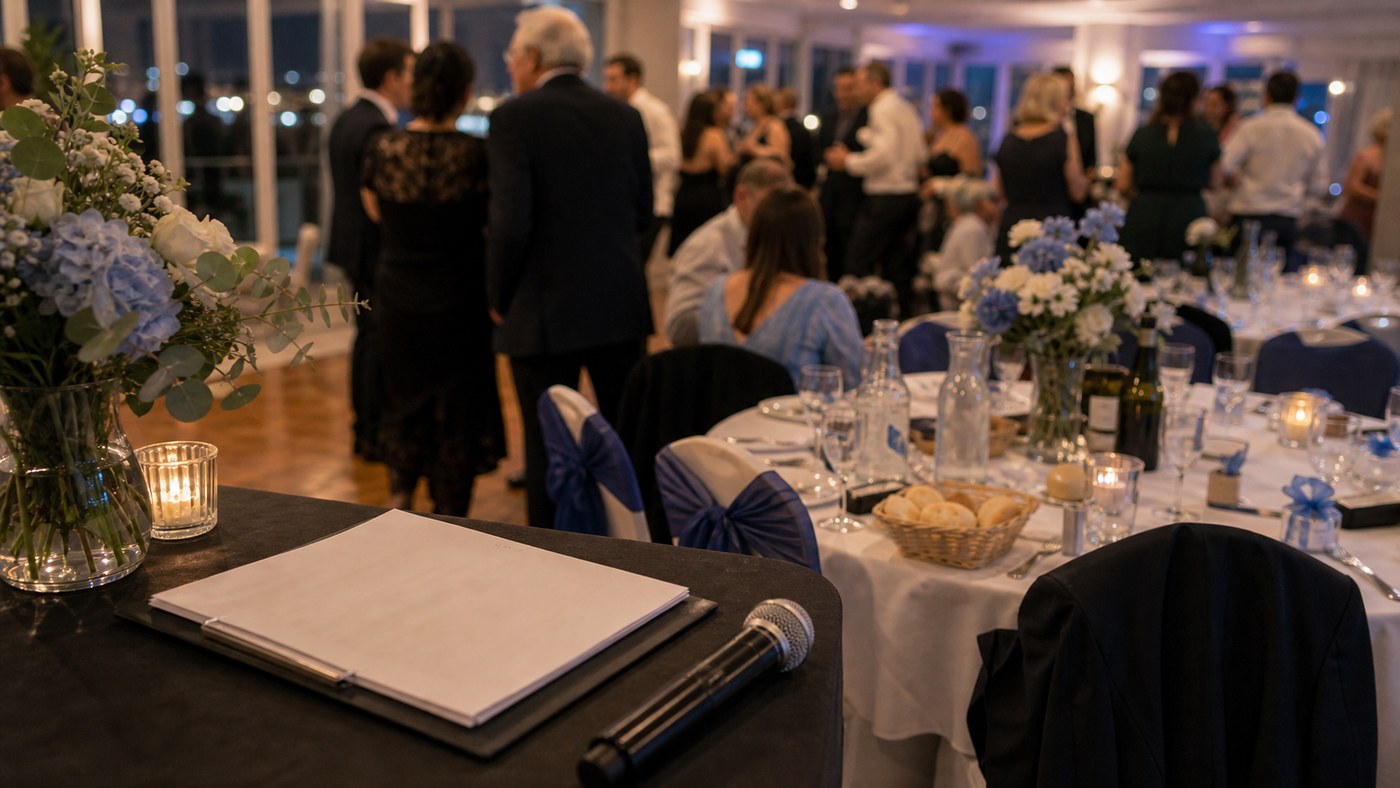
Lesson One: The Speeches Are the Intermission, Not the Show
At most Anglo-Australian weddings, the speeches are the emotional centrepiece. Everyone braces for the father of the bride, the best man does ten minutes of roast material, and the dance floor is the bit at the end for whoever's still standing.
A Greek wedding flips that completely. The dance floor is the show. The speeches are the breather between rounds. My job wasn't to build toward a big emotional crescendo at the microphone — it was to get people off their seats and onto the floor as fast as humanly possible, then stay out of the way.
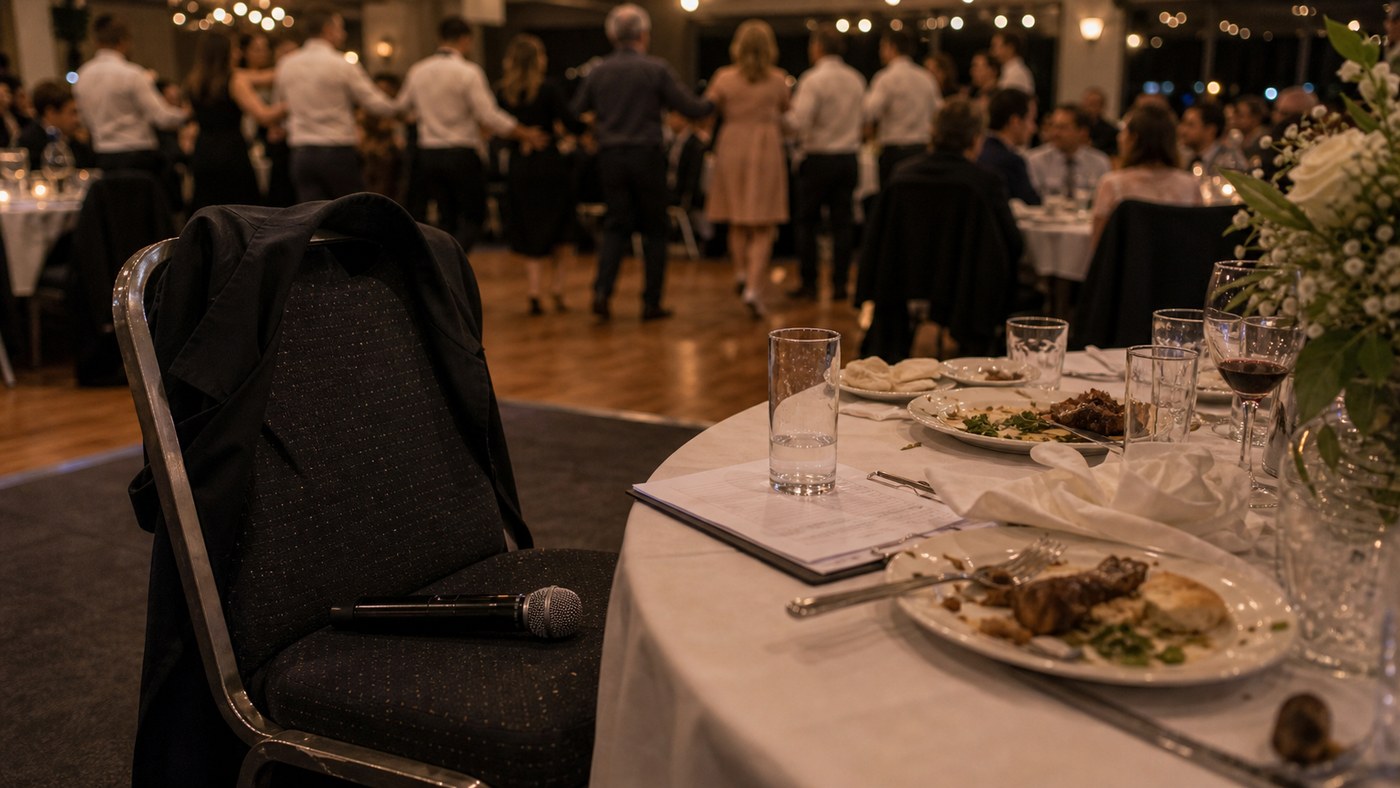
The first kalamatiano — the circle dance — started before mains were cleared. Nobody asked permission. The band just started, a great-aunt grabbed three teenagers by the wrists, and suddenly half the room was holding hands and spinning anticlockwise. My carefully scheduled "first dance segment" was now a formality happening two hours early.
Lesson Two: The Zeibekiko Is Sacred. Do Not Talk Over It.
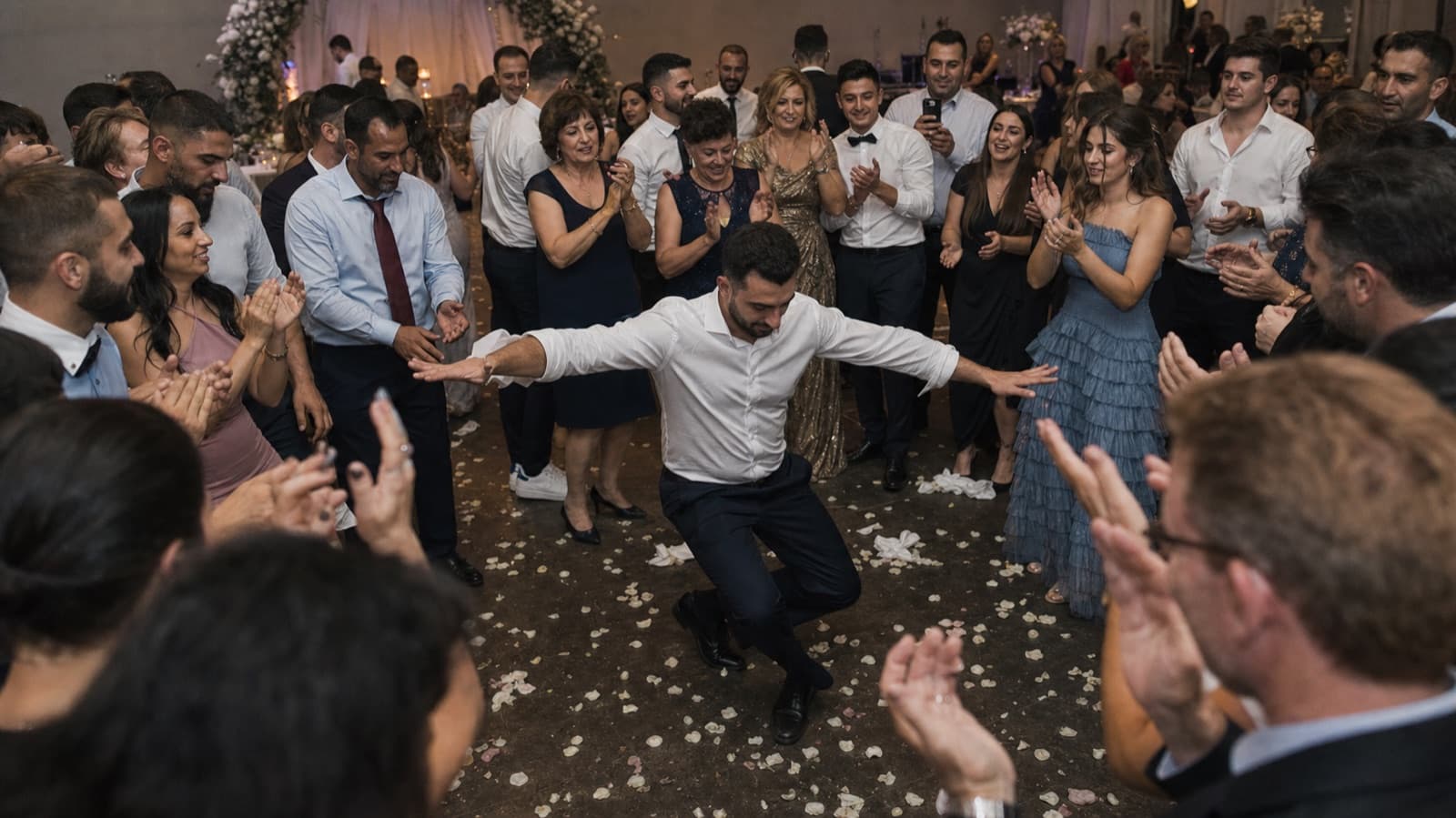
If you learn one thing from this post, learn this. The zeibekiko is a solo dance — slow, improvised, intensely personal. One person dances, low to the ground, arms out, while everyone else kneels in a circle around them and claps. It is not a party trick. It is somebody telling their whole story without words.
When the groom's father got up to dance one, I had a segue prepared. A little link into the cake cutting. I looked at the circle of people kneeling around this man — some of them crying — and I put the microphone down.
An MC who talks over a zeibekiko is an MC who has fundamentally misunderstood the assignment. Some moments don't need a voiceover. Knowing which ones is the entire skill.
Lesson Three: Yiayia in the Front Row Decides If You're Any Good
Here's the multilingual reality of a Sydney Greek wedding: the couple's friends speak English, half the parents' generation switches comfortably between both, and the front two tables — the grandparents, the great-aunts, the godparents who flew in from Thessaloniki — are operating almost entirely in Greek.
If your MC only works in English, those front tables spend the night politely waiting for someone to translate the room to them. They laugh four seconds after everyone else, if at all. At their own grandchild's wedding.
A bilingual MC doesn't just translate announcements. They split their energy between languages so that yiayia gets the joke at the same time as the groomsmen do. When the welcome went out in Greek first, the front tables didn't just smile — they owned the room for the rest of the night. That's not a nice-to-have. That's the difference between guests and spectators.
Lesson Four: The Money Dance Will Not Be Scheduled
At some point — and you cannot predict when — guests will start pinning money to the couple while they dance, or showering the dance floor with notes. There is no slot on the run sheet for this. It erupts. Your job as MC is to recognise it starting, signal the band, and protect it from interruption. The photographer will find you afterwards and thank you.
Same goes for the plate smashing question, which I get asked constantly: most Sydney venues banned actual plate smashing years ago. The energy survived just fine — it went into the dancing, the napkin waving, and the flowers thrown during the zeibekiko. Nobody misses the crockery except the people who never had to sweep it up.
So What Actually Survived the Run Sheet?
The entrance. The cake. The last dance. Everything else moved, stretched, swapped order or doubled in length. And the night was better for it.
The real lesson from Brighton-Le-Sands is that a Greek wedding doesn't need an MC who controls the room. It needs one who can read it — in two languages — and who knows that the best moments of the night were never going to be on the laminated page anyway.
Planning a Greek, Greek-Cypriot or any big-energy cultural wedding in Sydney? The Stage MC has bilingual MCs who already know what a zeibekiko is — no panicked googling required.
More from the blog


Planning an event of your own?
Tell us about it — we’ll hand-match an MC who fits the room, the language and the moment.