Mythbusted: A Bilingual Sydney Wedding Needs Two MCs. Wrong — Two MCs Is How You Get a Reception That Runs Twice as Long and Half as Warm.
Everyone in Hurstville and Cabramatta thinks a bilingual wedding means booking two MCs. It doesn''t. It means booking one who can actually do the job.

Here''s a sentence I hear at least once a week, usually from a lovely mum in Hurstville or an uncle in Cabramatta who has already made up his mind: "We''ll just get two MCs — one for English, one for Cantonese." Or Vietnamese. Or Korean, if we''re in Strathfield. Or Arabic, if the reception''s heading out to Lakemba.
And every time, I take a breath and say the same thing: please don''t.
It sounds sensible. Two languages, two people, one each. Tidy. Except it''s the single fastest way to turn a beautiful reception into a bloated, echoey, stop-start marathon where nobody laughs at the right time and Nan gives up and goes to find the dumplings. Let me bust this one properly.
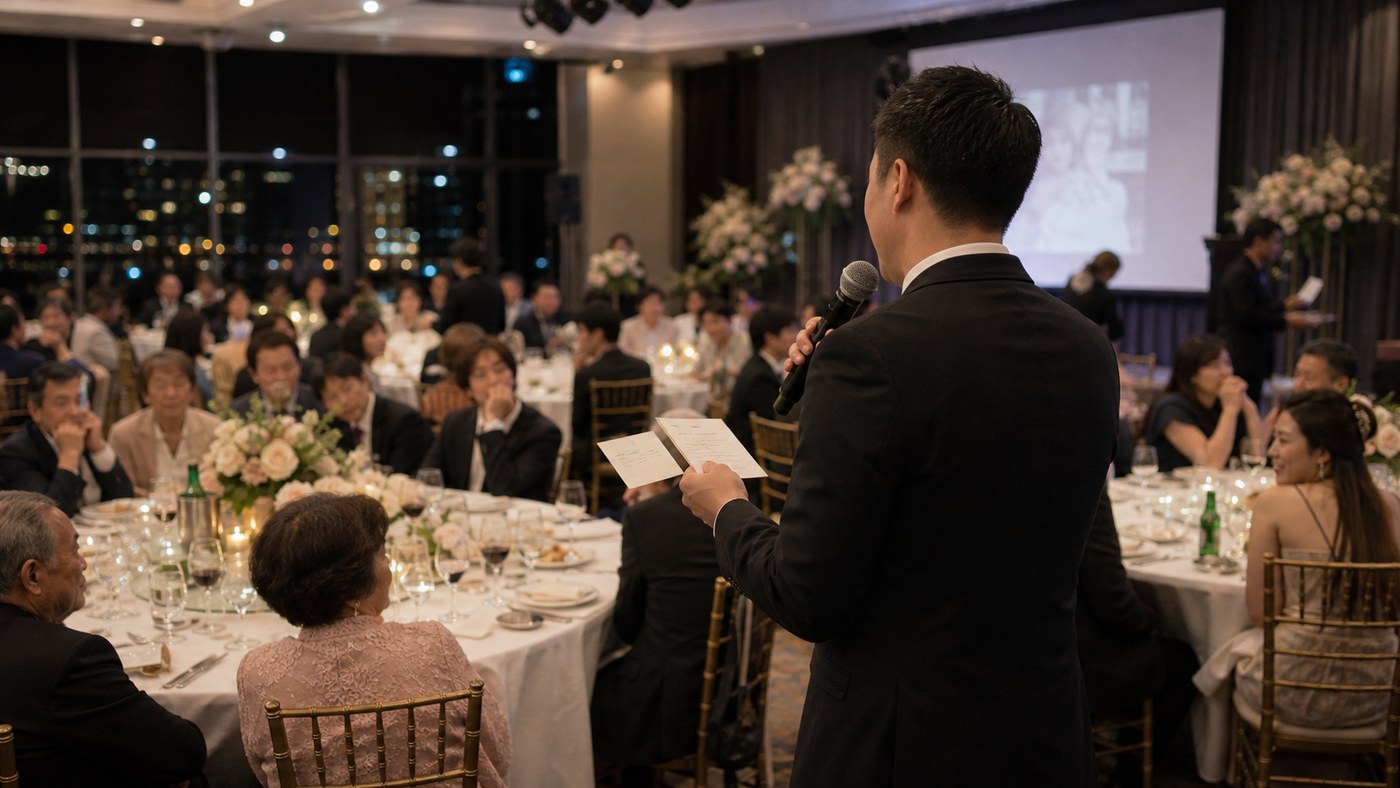
Where the myth comes from (and why it feels right)
The logic is understandable. You''ve got a room where half the guests speak one language and half speak another — the groom''s side flew in from overseas, the bride''s side grew up in Eastwood. You want everyone included. So you think: two mics, two voices, fairness. Nobody gets left out.
The problem is that inclusion isn''t about literal word-for-word coverage. It''s about energy. And energy doesn''t survive being run through a relay race.
What actually happens with two MCs
Picture it. MC number one delivers the welcome in English. Warm, gets a chuckle, good start. Then he steps back and MC number two delivers the same welcome in Cantonese. Except the joke has already landed once, so the second delivery is just… information. The English-speakers switch off because they''ve heard it. The Cantonese-speakers get a slightly deflated version because the room already peaked ninety seconds ago.
Now multiply that by every single announcement across the night. Welcome. Grand entrance. First speech intro. Cake. First dance. Tea ceremony. Each one delivered twice, back to back, with a little awkward handover in between. Your ninety-minute formalities block is now two and a half hours. The kitchen is panicking. The band is watching their overtime clock. And the vibe has flatlined because the room has spent the whole night hearing everything in stereo, badly.
Two MCs also almost never rehearse together properly. So you get overlaps, gaps, two different senses of humour, two different volumes, and one very confused DJ trying to work out whose cue is real.
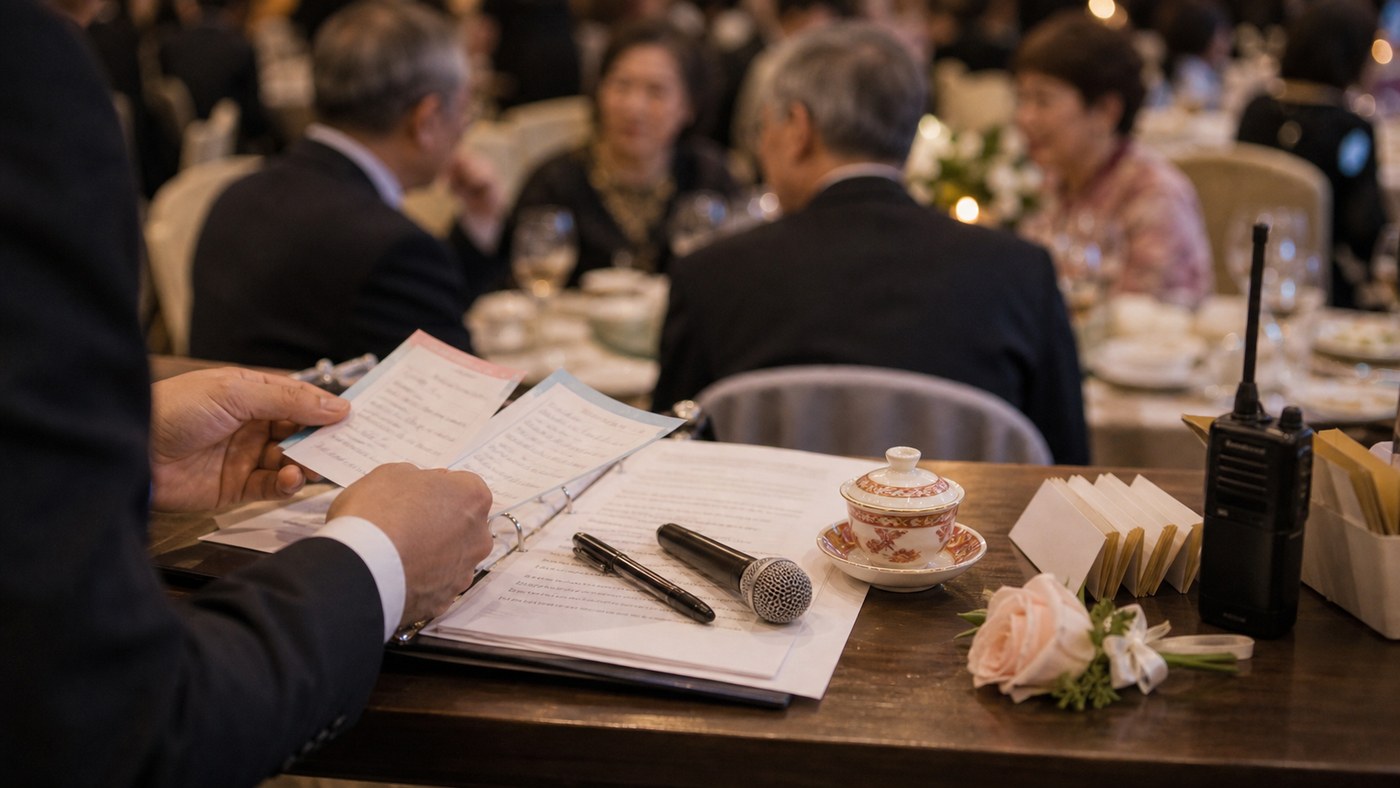
What one good bilingual MC does instead
A proper multilingual MC doesn''t translate. They curate. That''s the whole trick, and it''s the bit couples don''t know to ask for.
It looks like this. The grand entrance announcement goes out with full theatrical energy in the primary language of the room — say English — and then a tight, punchy Cantonese line lands on top, not as a translation but as its own beat. The names, the "please stand," the big moment. Ten seconds, not ninety. Both sides feel spoken to. Nobody feels like they''re sitting through the rerun.
For the emotional stuff — a father''s speech intro, a tea ceremony, a moment for grandparents who''ve travelled a long way — the good MC knows which language owns that moment and leads with it, then bridges. They read who''s actually in the room. They know that in a Vietnamese reception in Cabramatta, the toast timing and the way you honour the elders isn''t a footnote you translate afterwards; it''s the spine of the run sheet, and the English gets threaded around it.
Here''s what a single bilingual MC gives you that two never can:
- One nervous system for the room. The pacing, the energy, the reading of when a table has gone flat — that all lives in one head. It can''t be split across two people passing a mic.
- Half the airtime, double the warmth. Every announcement lands once, cleanly, in a form both sides get. You claw back an hour of your night.
- No handover deadzone. The awkward "and now my colleague will…" shuffle simply doesn''t exist.
- Actual jokes. A bilingual MC can make a joke that works in both languages, or make a language itself the punchline — the Hinglish gag, the Cantonese aside the aunties catch a half-second before everyone else. Two MCs can''t do that. It has to live in one brain.
When two MCs actually is the right call
Because I''m not a zealot: there are real exceptions. If your two languages have genuinely no overlap in the room — two completely separate guest groups who''ll barely interact — and you''re essentially running two receptions stitched together, sometimes a co-host structure earns its keep. Huge multi-hundred-guest weddings with a formal ceremony component in one language and a party in another can justify it too.
But that''s a deliberate production decision you make with your MC, not a default you reach for because it sounds fair. And even then, the two need to rehearse together like a double act, not turn up as strangers sharing a stage.
The actual question to ask
So when you''re booking, stop asking "how many MCs do we need for two languages?" Wrong question. Ask instead: "Can you actually host — not just translate — in both of our languages, and how do you handle the moments that belong to one side more than the other?"
If they start talking about curating energy, leading with the right language for each moment, and keeping the room in one piece, you''ve found the one. If they say "sure, I''ll just repeat everything twice," keep looking.
Your wedding isn''t a subtitled film. It''s a party where two families become one. You want that to feel like one room, one night, one story — not a document read aloud in two columns. One MC who can genuinely hold both languages is how you get it. Sydney is full of couples who wish someone had told them this before they booked two.
Consider yourself told.
More from the blog


Planning an event of your own?
Tell us about it — we’ll hand-match an MC who fits the room, the language and the moment.