Behind the Scenes: I MCed a Lebanese Wedding in Lakemba. The Zaffe Walked In and Tore Up My Run Sheet in the First Ninety Seconds.
A drumline, a wall of sound, and 250 guests on their feet before the entrées. Here''s what a Lakemba zaffe taught me about who really runs a room.

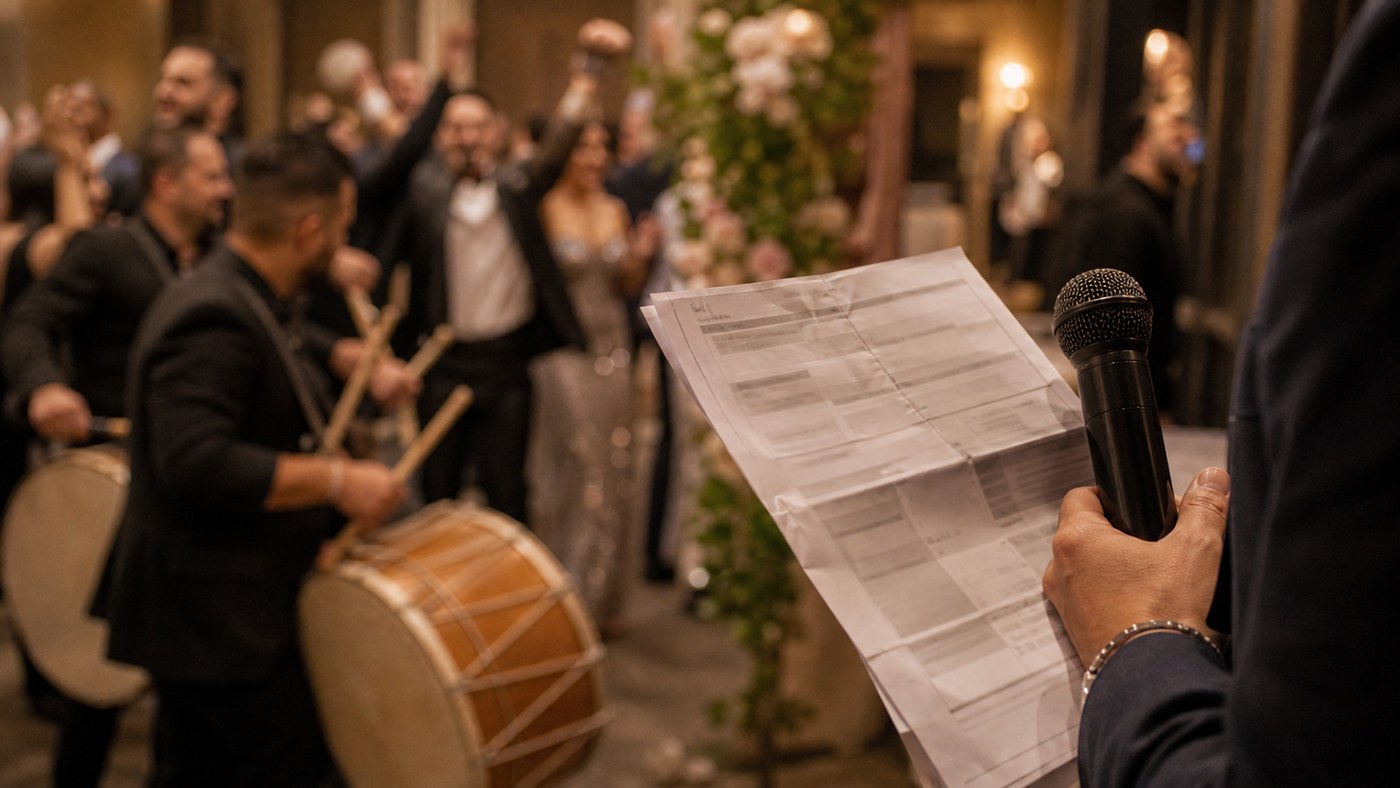
I have MCed a lot of Sydney weddings. Corporate-smooth ones in the CBD. Hushed, candlelit ones on the North Shore. I thought I knew what "big entrance" meant. Then I stood at the back of a reception hall in Lakemba, clipboard in hand, run sheet timed to the minute — and the zaffe walked in.
Ninety seconds later my run sheet was decorative.
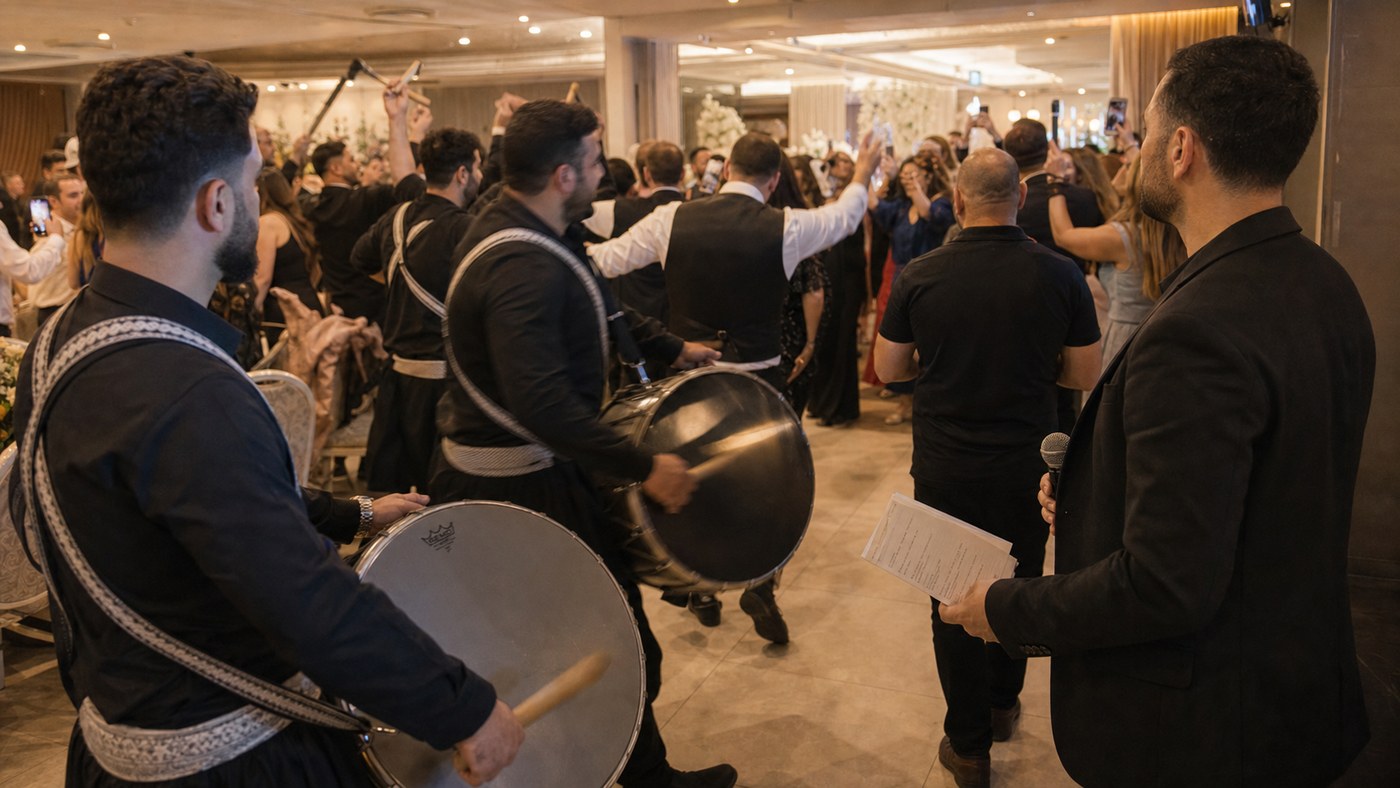
If you have never seen a Lebanese zaffe, here is the short version: it is the traditional wedding entrance, and it is not an entrance so much as an arrival of weather. Drummers. A wall of derbake and sometimes bagpipes. Dabke dancers moving in a tight, stamping line. The couple carried in on a tide of noise, family, and phone torches held up like a small galaxy. It does not ask the room to pay attention. It takes the attention, physically, and hands it to the bride and groom.
What no one tells the MC
Here is the thing they don''t warn you about: during the zaffe, you are not in charge. You are furniture. And the fastest way to look like an amateur is to fight it — to grab the mic and start "hosting" over the top of a drumline that has been perfecting this exact three minutes for longer than you have been alive.
The good MC does the opposite. You shut up. You get out of the sightline. You let the zaffe troupe own the floor completely, because right now they are better at running this room than you are, and everybody in it knows the choreography except you.
My job wasn''t to lead those ninety seconds. It was to catch the room the instant the drums stopped — that half-beat of silence when 250 people are buzzing, breathless, and suddenly leaderless. Miss that beat and the energy leaks out onto the dance floor and the speeches. Catch it, and you ride the wave straight into the night.
The bilingual trapdoor
Then there is the language. Roughly half the room spoke Arabic first, English second. The couple''s Aussie-raised friends were the reverse. Teta in the front row was not going to laugh at an English pun, and the groomsmen at table nine were not going to sit through a two-minute Arabic aside they couldn''t follow.
The lazy fix is to say everything twice. Announce in English, repeat in Arabic, watch the whole night run at half speed while both halves of the room quietly check their phones during the version they don''t need.
The real fix is rhythm. You carry the announcements in English — clear, fast — and drop the warmth, the blessings, the little jokes to the aunties, in Arabic. Not a translation. A second conversation running in parallel, so both halves of the room feel personally hosted without either one waiting. That is the entire edge of a genuinely bilingual MC, and it is invisible when it works and excruciating when it doesn''t.
Suburb matters more than venue
People assume the venue sets the tone. At a Lakemba or Auburn wedding, the community sets the tone and the venue just holds it. The same hall, booked by a different family from a different Sydney, would run like a completely different event — quieter, tighter, more speeches, less floor.
So when someone tells me "it''s a wedding, you''ve done a hundred," I''ve learned to ask a better question first: whose wedding, in whose suburb, in whose language? A reception in Lakemba, a Vietnamese banquet in Cabramatta, a Samoan celebration out west, a Sunday lunch-turned-party in Leichhardt — these are not the same job with different catering. They are different jobs.
What the zaffe actually taught me
The lesson wasn''t about drums. It was about ego. The best moments of that night were the ones I didn''t run — the zaffe, the dabke line that pulled half the guests in, the moment Teta grabbed the mic to bless the couple and I just... stepped back and let her.
A weak MC needs to be the main character. A good one knows exactly when the room has a better main character than you, gets out of the way, and is ready — mic warm, first line loaded — for the half-second the spotlight comes back.
My run sheet said I ran the night. The zaffe corrected me in ninety seconds. Best note I got all year.
Planning a bilingual or multicultural wedding in Sydney and want an MC who knows when to lead and when to disappear? Tell us about your night and we''ll hand-match you.
More from the blog


Planning an event of your own?
Tell us about it — we’ll hand-match an MC who fits the room, the language and the moment.